Thursday, February 9, 2012
Written Assignment 5
As has been demonstrated in the lectures this week, Native American religious practices changed as their societies had to meet new challenges. What were those changes? What kinds of challenges were these changes meant to meet? Can you think of a modern analogy to these changes in current religious practices. Your answer should take the form of a 2-3 page machine-produced paper, with conventional 1 inch margins, and is due at the beginning of class on Thursday, February 16.

Monday, February 6, 2012
The Emergence of Native Prophets
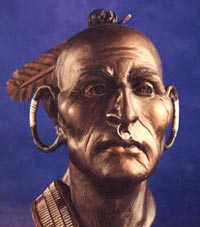
I. The Delaware Prophet Neolin
A. A. Origin of the term “prophet”—not a word that natives used to designate the religious leaders, but a term used by whites to compare these natives—unfavorably—to Old Testament prophets.

B. B. Changing Native Cosmology—the stress that native societies were undergoing during this time—due to the introduction of European microbes, for which natives had no cure, their increased reliance upon European trade goods, which they were finding they could no longer do without, the introduction of alcohol, with its debilitating effects on native societies—all worked to make native Americans more receptive to the new message that these native prophets were preaching. The dislocation of native culture that occurred because of the difficult adjustments natives had to make because of European contact prompted many natives to begin to question their long accepted cosmology, and the be receptive to new interpretations about their place in the world.

1. 1. Life after death—native beliefs held, before European contact, that all natives (except those who died in infancy) would go on to reside in an afterlife when they died—one’s place in that afterlife was not determined by how on lived one’s life while on earth. In part, this was probably due to the widespread native belief that one could travel back and forth between the present life and the afterlife through dreams. Native prophets adapt the idea of heaven and hell to attempt to compel native peoples to give up the European creature comforts and return to “traditional ways” to appease the Great Spirit. Those who chose to follow the narrow, difficult path would find there way to the Great Spirit in death, while those natives who remained unreformed would find themselves suffering the fire of a place similar to the Christian hell for all eternity.
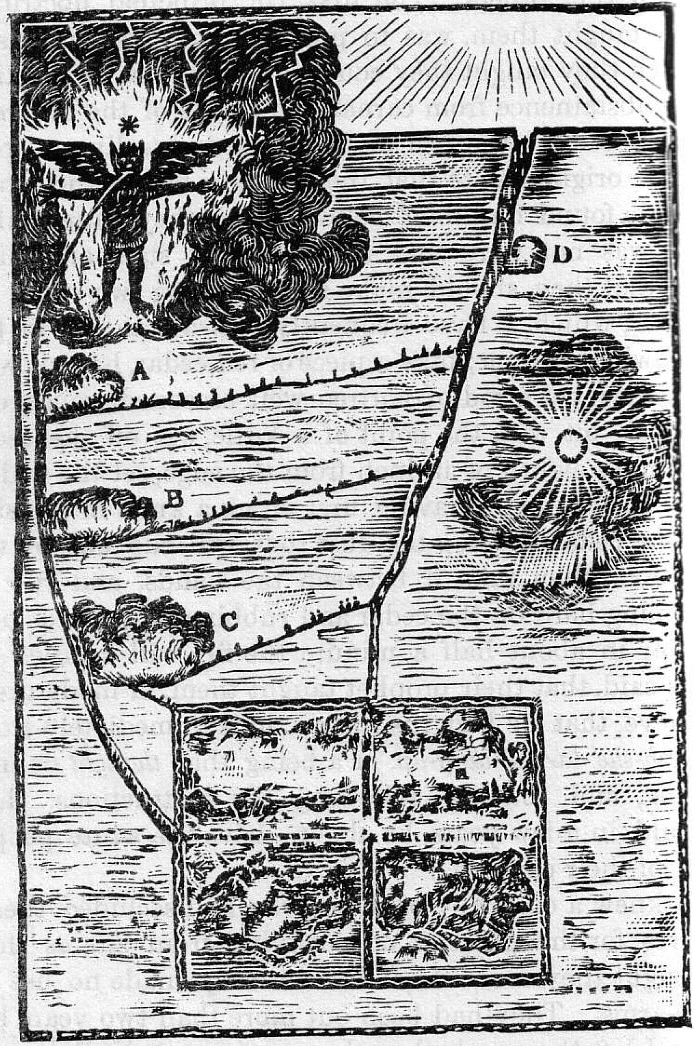
2. 2. Proscribed behaviors—before European contact, native peoples had no proscribed behaviors; in other words, there was nothing equivalent to the Judeo-Christian Ten Commandment (although there were community pressures brought on individuals who did not act in what were perceived as the best interests of the community). This changes as prophets become more prominent—in order to meet the Great Spirit at the end of one’s life, one had to be monogamous, treat the one wife gently and respectfully, give up alcohol and other European trade goods, return to hunting the animals of the forest in a respectful manner (rather than killing most for their fur, to gain European trade goods). Native peoples were also called upon to give up the use of magic and spells (“witchcraft”), since that called upon assistance from the “Evil One” who closely resembled the Devil of Christianity.
3. 3. The Importance of a Transcendent Vision—the revelations were claimed by the various prophets to be the result of a vision in which the Great Spirit spoke directly to the prophet, and revealed the importance of implementing these new practices—and the renewal of traditional practices—to them. This, of course, made the visions more real for the natives—but raised doubts about their veracity among whites (who called these prophets “imposters” and “charlatans” as well) since these visions did not include visits from the Christian Holy Trinity—Father, Son, and Holy Ghost.

C. C.T he Delaware—in order to better understand the emergence and importance of the Delaware Prophet Neolin, we need to have a greater historical understanding of the Delaware—or Lenape—people.

1. 1. Early European contact—the Lenape people inhabited the Delaware Valley of eastern Pennsylvania, New Jersey, and in southern New York when European traders entered the valley in the middle 1620s. By the 1640s, the Lenape had emptied the forest in their area of large game for the fur trade, the Dutch turned to peoples in the interior part of the country—particularly the Iroquois—to provide the valuable furs, and the Lenape were dependent upon selling handcrafts and other goods for rum with the Europeans.
2. 2. One-sided treaties—although the Lenape faired well when dealing with the founder of the colony, William Penn, his offspring were not as trustworthy. Most famously, the Walking Purchase (or Walking Treaty) was an instance of outright fraud. The “treaty” upon which the transaction was based was a forgery, and the purchase itself—which we discussed last class period—was gained under false pretenses.
3. 3. Withdrawal to the interior—shortly after the Walking Treaty experience, the Lenape abandoned their traditional homeland to reside in the interior of the country, away from contact with the Europeans. Depopulation and demoralization had taken their toll, and their population had diminished from estimated 11,000 to less than 3,000 by the 1730s.
4. 4. Creating a new ethnic identity—at first contact, they Delaware had no ethnic identity; they were merely scattered villages that shared two dialects of a common language. The crises they went through forged an ethnic identity for them, however, and by the 1730s they were no longer the thumb of the Iroquois, and were communicating with other native peoples (including the Shawnee) with ideas about a common native identity.

D D. The French and Indian War—as it is known in North American, but as Winston Churchill observed, it can perhaps truly be called the first World War, and Great Britain and France fought each other (with and through their allies) all around the globe—Asia, Africa, the Caribbean, North America, as well as each other in Europe. The war began an a young, inexperienced Virginia militia officer by the name of George Washington ambushed a French patrol, but were captured by French forces from nearby Fort Duquesne before they could escape.
1 1. The French Surrender in North America—Early French success in the conflict in North America cause the fall of the British government, and William Pitt became Prime Minister. Pitt committed large numbers of troops to the conflict in North America, which the French were unwilling to do (they were concerned about the Prussian threat on their eastern border in Europe, and therefore could not afford to commit the resources to North American that the British could. The result was the capture of Montreal by the British in 1760, and the surrender of French claims on the continent as a result. This agreement bewildered the native allies of the French, who did not understand how they could lose no battles, make no treaty, and still lose land in the agreement.
2. 2. Proclamation line of 1763—In order to bring government costs in North America under control, the British government made a series of agreements with native peoples in 1763, promising no further European incursion west of the Allegheny Mountains.
Thursday, February 2, 2012
Written Assignment 4
Although many Native America peoples shared a variety of cultural practices, and spoke closely-related if different languages, they saw themselves as distinctive peoples, as different as Germans are from the French today. What factors do you think helped them make these distinctions, and what factors helped to eventually blur those distinctions? Your answer should take the form of a 2-3 page paper, with 1 inch margins, handed in at the beginning of class on Thursday, February 9.
Wednesday, February 1, 2012
Instability in the Pays d'en Haut

A. The New Way of War--The invasion of Huronia and the near total destruction of the Hurons created a great deal of instability in the Great Lakes regions--the pays d'en haut, as the French referred to it. This new style of war (and the technology that accompanied it) introduced by the Iroquois frightened other native peoples, who often sought to keep as much distance between themselves and the Iroquois as possible.
1. Continued Iroquois incursions--native peoples terror of the Iroquois was founded on the fact that for much of the next decade after wiping out the Hurons, they continued to return to the region to ensure that they maintained a monopoly over its resources--and to seek captives to replace the population that was lost in this operation, and to disease.
a. Miami-Seneca clash--the Miami thought they had made an alliance with the Seneca, but while Miami warriors were off fighting southern rivals, a contingent of Seneca wiped out their village, killing or kidnapping everyone but one old woman. The Miami pursued the Seneca, who left a trail of gruesome dead children as trail markers. The Miami were able to catch and ambush most of the Seneca party--except those they torture and maimed to send back to the Seneca village they came from.
2. Finding Allies--the threat of attack from the Iroquois led other Indian peoples seeking allies to assist them in resisting the Iroquois. It was the need to seek allies that led many Algonquin people into the arms of the French.
B. Creation of the Mingoes--Not everyone in Iroquoia approved of this new way of war. A group of dissident Seneca and other (smaller) numbers of Iroquois separated from the main body, set up their own village in northeastern Ohio, and began to be referred to as the Mingo.
II. The Migration of the Shawnee
.jpg)
1. Shawnee and pan-nativism--Much of the difficulty Native Americans experienced with Euro-Americans was that they had great difficulty seeing themselves as a single people--as Indians. That was a label given to them by Europeans, not one they labeled themselves with (until much later, that is). Euro-Americans made little or no distinction between various Native peoples; as we will see later in this course, for many Euro-Americans living near the "frontier," they felt no compulsion to differentiate between various native groups when they retaliated for some perceived wrong. During their travels--or, perhaps, because of their travels--the Shawnee developed a larger consciousness that all Native Americans were somehow related to one another, that they were at root one people. This heritage defined the work of Tenskwatawa and Tecumseh, as we will see.
2. Algonquin identity--we tend to think that ethnic identity is a static thing, but in the late 17th century that was not the case. Algonquin people--particularly the Shawnee--might incorporate through adoption many different people. Although the Shawnee did on occasion torture captives, they most often adopted them into their kin groups. These adoptees were often so well treated that on occasions when the Shawnee were forced to turn over these adoptees, many tears were shed by both sides because of the separation.


Tuesday, January 31, 2012
Disease and Diplomacy
I. Disease and Medicine
A. Iroquois Medical Practices
 1. Treating Mind and Body--Before European contact, many native peoples--especially the Iroquois--kept those who had fallen ill among them, rather than isolating them in a sick room or something approaching a hospital. In this way, those who had fallen ill or were injured were made to feel that they were still an integral part of the community, which undoubtedly helped to foster recovery from the kinds of illnesses native peoples suffered from in the years before European contact. With the introduction of European communicable diseases, however, this became a recipe for disaster; keeping people ill with smallpox, for instance, among those not already infected by the disease ensured wider infection of the populace.
2. Medical Practice--natives relied upon "natural" remedies--meaning those not dreamed up by European medical professionals, like bleeding, using purgatives, emetics, and blistering agents as antidotes for a variety of diseases, as well as medicines like tincture of mercury, which slowly poisoned the body (and by using on a long-term basis, could cause dementia--hence the term, "mad as a hatter").
 3. Visions and Health--Again, in the readings in Jesuit Relations regarding health and medicine, we are reminded of the importance native peoples placed upon visions or things imagined while in a state of altered consciousness. Our Jesuit correspondents again emphasize their incredulity at the importance natives placed placed upon the visions that occurred to them--and at the lengths they would go to to make the dreams come true--particularly those that pertained to the erotic. Nonetheless, for the Huron (and other Iroquois people) these dreams and visions were very important--"more real the reality."
a. Alcohol and the Altered Conscious--most native peoples sought to achieve a state of altered consciousness, from which they would have visions that would tell them what their life's purpose would be. Often, native peoples ingested a variety of herbs and fungi (peyote, psilocybin mushrooms). When you read any account of native peoples and alcohol during this time period, you inevitably see descriptions of people being falling down drunk. Over the years, historians have attempted a variety of explanations for this behavior--a genetic intolerance for alcohol, depression over the changes to their lives, the massive loss of kin, etc. I argue, however, that the damage done to native communities by alcohol was largely the result of their need to seek these altered states of consciousness. Acts committed while drunk--even when severe--were largely forgiven by native communities, who recognized that a person who committed such a crime while drunk was not able to control themselves, and therefore not completely accountable for their actions.
II. Diplomacy and War
 A. Native diplomacy--Diplomacy was facilitated by trade. Diplomacy was not always the favored tactic of native peoples, of course, who often resorted to war when trade negotiations broke down. While many people were killed during these disputes, they tended to be about territorial disputes--not, significantly, over "ownership" of a particular piece of land, and who held the rite to cell it.
B. Native Wars--Native wars tended to usually be low-grade conflicts. Men usually fought until they either overcame, or were themselves overcome by, their opponents. These men then would be marched back to the village, where they would slowly be tortured to death--or, on rare occasions, pardoned and given to a family who had recently lost a member. Families would be given this replacement as a way of renewing that family--and, by extension, renewing the tribe, anyway.
 1. Pequot War--disputes between groups of Puritans and an Indian people called the Pequot broke out in 1637-1638. The Pequot in the early months of the dispute had run of the battlefield, won numerous victories over the groups of Puritans. The tide turned, however, when the Puritans began burning down Pequot villages, including all the buildings and the villages granary, where the Pequot stored their seed corn. The culmination of the fighting happened at Fort Mystic, which the Puritans burned to the ground and murdered everyone (noncombatants, among them women and children. This action the Mohawk observed from a safe distance, and began talks with the other Iroquois peoples to use those kinds of tactics against the Huron, who controlled a substantial amount of land with lots of beavers.
2. Mohawk leadership--the native people we know as the Mohawks were able to observe this conflict from a safe distance (from the far side of the Hudson Valley), and began to advocate for a change in tactics in order to cut off the Huron from any action on the turn trade.
 3. The Destruction of the Huron--On March 16 of 1649, a small contingent of an Iroquois force in excess of 1,000 warriors attacked St. Ignace, killed many of he men attempted to save the settlement--including Fr. Brebeuf, who the Iroquois slowly tortured to death--used the woman and children as pack animals, and escaped south. Several other Huron settlements were likewise attacked during this period. These attacks were extraordinary for several reasons--the level of coordination among the various Iroquois nations and the logistics of moving that many men on foot. Just as significant, however, was the timing of the attack, in mid-March, when food supplies were at there lowest level. By destroying what they couldn't carry away, the Iroquois also prevented the Huron from planting food in the spring, and ensured they would have to leave what they considered their homeland in order to survive.
 C. Unintended Consequences--while destroying most of the Huron, and therefore opening up the Huron lands for their own exploitation. The Iroquois had also hoped to eliminate the French from the area, since they sided with their enemies, the Hurons, in the struggle. The result of losing their allies among the Huron was that the French sent more trained military troops, and more French settlers, determined to maintain their presence in "New France." This development, along with the surrender of control by the Dutch to the English of New Amsterdam (which the English began calling "New York"), changed the trading relationships the Iroquois had developed, as well. The result of this is perhaps best exemplified by a woman on here way to becoming the newest saint in the Roman Catholic Church--Kateri Tekakwitha, a woman who grew up among the Mohawks, but chose to live her short life as virgin devoted to venerating Jesus Christ through the mortification of her own flesh.
A. Iroquois Medical Practices
2. Medical Practice--natives relied upon "natural" remedies--meaning those not dreamed up by European medical professionals, like bleeding, using purgatives, emetics, and blistering agents as antidotes for a variety of diseases, as well as medicines like tincture of mercury, which slowly poisoned the body (and by using on a long-term basis, could cause dementia--hence the term, "mad as a hatter").

a. Alcohol and the Altered Conscious--most native peoples sought to achieve a state of altered consciousness, from which they would have visions that would tell them what their life's purpose would be. Often, native peoples ingested a variety of herbs and fungi (peyote, psilocybin mushrooms). When you read any account of native peoples and alcohol during this time period, you inevitably see descriptions of people being falling down drunk. Over the years, historians have attempted a variety of explanations for this behavior--a genetic intolerance for alcohol, depression over the changes to their lives, the massive loss of kin, etc. I argue, however, that the damage done to native communities by alcohol was largely the result of their need to seek these altered states of consciousness. Acts committed while drunk--even when severe--were largely forgiven by native communities, who recognized that a person who committed such a crime while drunk was not able to control themselves, and therefore not completely accountable for their actions.
II. Diplomacy and War

B. Native Wars--Native wars tended to usually be low-grade conflicts. Men usually fought until they either overcame, or were themselves overcome by, their opponents. These men then would be marched back to the village, where they would slowly be tortured to death--or, on rare occasions, pardoned and given to a family who had recently lost a member. Families would be given this replacement as a way of renewing that family--and, by extension, renewing the tribe, anyway.

2. Mohawk leadership--the native people we know as the Mohawks were able to observe this conflict from a safe distance (from the far side of the Hudson Valley), and began to advocate for a change in tactics in order to cut off the Huron from any action on the turn trade.


Wednesday, January 25, 2012
Written Assignment 3
Most of this week's lectures have attempted to deal with the relationship between mythology and history. Are these two traditions complimentary, or contradictory? Why? Can you use one methodology to understand the other? What do you thing the pitfalls of this would be.
This assignment should fill at least two full, machine-produced pages, and it is due at the beginning of class on Thursday, February 2.
This assignment should fill at least two full, machine-produced pages, and it is due at the beginning of class on Thursday, February 2.
Shawnee Culture


B. Native Peoples in the Ohio Valley


The Hopewell culture developed from the preceding Adena culture, but the Hopewell culture built much larger earthworks and greatly expanded the area from which it obtained exotic raw materials, such as shells from the Gulf of Mexico, copper from the Great Lakes region, mica from the Carolinas, and obsidian from the Rocky Mountains. The archaeologist N'omi Greber refers to the rise of the Hopewell culture as an "explosion" of art, ritual, and ceremonial architecture.
The earliest evidence for the Hopewell culture is in Illinois, but the most spectacular earthworks are in southern Ohio and Indiana north of the Ohio River, especially in the valleys of the Great and Little Miami, Scioto, and Muskingum rivers. The Newark Earthworks, Ohio's official prehistoric monument, is the largest set of geometric earthworks built by the Hopewell culture. The Fort Ancient Earthworks, in Warren County, is the largest example of a hilltop enclosure. The largest set of Hopewell burial mounds is at the Mound City Group in Chillicothe. All three of these sites are National Historic Landmarks and all are being considered for nomination as World Heritage sites. These large earthwork sites were not cities. They were places of ceremony, including rituals related to the burial of the honored dead.

The Hopewell people lived in small villages, or hamlets, scattered throughout the river valleys of southern Ohio where they grew a variety of crops, including sunflower, squash, goosefoot, maygrass, and other plants with oily or starchy seeds. They also gathered wild plants, hunted for deer and other large and small game, and fished. The earthworks also must have served as places for these dispersed groups to gather periodically to renew friendships and socialize.
The Hopewell culture had leaders, but they were not like powerful rulers who could command armies of slaves and soldiers. Many people from different villages worked together to build these large mounds and enclosures. The Hopewell "explosion" was brilliant, but brief. It was all over by AD 400. The reasons for the decline of the Hopewell culture are not well understood. The shift during the succeeding Late Woodland period to larger villages surrounded by walls or ditches hints that increasing conflict may have been one factor in the abandonment of the earthworks and the far-flung networks of exchange.

3. Cahokia Mounds--years after the decline of the Hopewell tradition, a new native culture developed a couple of hundred miles to the west, in the Mississippi River Valley, about 10 miles east of present-day St. Louis. The site known as Cahokia, at its height, was probably one of the largest "cities" in the world, with a population in 1250 greater than that of London.
According to archaeological finds, the city of Cahokia was inhabited from about A.D. 700 to 1400. At its peak, from A.D. 1050 to 1200, the city covered nearly six square miles and 10,000 to 20,000 people lived here. Over 120 mounds were built over time, and most of the mounds were enlarged several times. Houses were arranged in rows and around open plazas, and vast agricultural fields lay outside the city.
The site is named for the Cahokia subtribe of the Illiniwek (or Illinois tribe, a loose confederacy of related peoples), who moved into the area in the 1600s. They were living nearby when the French arrived about 1699. Sometime in the mid-1800s, local historians suggested the site be called "Cahokia" to honor these later arrivals
The fate of the prehistoric Cahokians and their city is unknown, but the decline seems to have been gradual, beginning around the 1200s. By A.D. 1400 the site had been abandoned. Exactly where the people went or what tribes they became is yet to be determined.

Depletion of resources probably contributed to the city's decline. Climate change after A.D. 1200 may have affected crop production and the plant and animal resources needed to sustain a large population. War, disease, social unrest, and declining political and economic power may have also taken their toll.

4. Fort Ancient Culture--developed about 1000ACE; like Cahokia, Fort Ancient Culture explodes with the introduction of the cultivation of maize.
The Fort Ancient culture thrived in southern Ohio and northern Kentucky. Villages were made up of a number of circular or rectangular houses surrounding an open plaza. The Fort Ancient people continued to build small burial mounds, but gradually shifted to burials in a cemetery area with no mounds.
Fort Ancient features 18,000 feet of earthen walls built 2,000 years ago by American Indians who used the shoulder blades of deer, split elk antler, clam shell hoes and digging sticks to dig the dirt. They then carried the soil in baskets holding 35 to 40 pounds. Portions of these walls were used in conjunction with the sun and moon to provide a calendar system for these peoples. There is evidence that the Fort Ancient culture built Serpent Mound in Adams County, Ohio. They also may have built the "Alligator" Mound of Licking County.
5. Early Shawnee Culture--Uncertainty surrounds the eventual fate of the Fort Ancient people. Most likely their society, like the Mississippian culture to the south, was severely disrupted by waves of epidemics from new infectious diseases carried by the very first Spanish explorers in the 16th century. After 1525 at the Madisonville-type site, the village's house size becomes smaller and fewer with evidence to be "a less horticulture-centered, sedentary way of life".There is a gap in the archaeological record between the most recent Fort Ancient sites and the oldest sites of the Shawnee, who occupied the area at the time of later European (French and English) explorers. It is generally accepted that similarities in material culture, art, mythology, and Shawnee oral history linking them to the Fort Ancients can be used to establish the shift of Fort Ancient society into historical Shawnee society.

The Shawnee traditionally considered the Lenape (or Delaware) their "grandfathers". The Algonquian nations of present-day Canada regarded the Shawnee as their southernmost branch. Along the East Coast, the Algonquian-speaking tribes were mostly located in coastal areas, from Quebec to the Carolinas. Algonquian languages have words similar to the archaic shawano (now: shaawanwa) meaning "south". However, the stem shaawa- does not mean "south" in Shawnee, but "moderate, warm (of weather)". In one Shawnee tale, Shaawaki is the deity of the south.
Before contact with Europeans, the Shawnee tribe consisted of a loose confederacy of five divisions which shared a common language and culture. The division names have been spelled in a variety of ways. The divisions are:
- Chillicothe (Principal Place), Chalahgawtha, Chalaka, Chalakatha;
- Hathawekela, Thawikila;
- Kispoko, Kispokotha, Kishpoko, Kishpokotha;
- Mekoche, Mequachake, Machachee, Maguck, Mackachack, etc.;
- Pekowi, Pekuwe, Piqua, Pekowitha.
In addition to the five divisions, the Shawnee can be divided into six clans or subdivisons. Each name group is common among each for the five divisions and each Shawnee belongs to a group.The six group names are:
- Pellewomhsoomi (Turkey name group)—represents bird life,
- Kkahkileewomhsoomi (Turtle name group)—represents aquatic life,
- Petekoθiteewomhsoomi (Rounded-feet name group)—represents carnivorous animals like the dog, wolf, or whose paws are ball-shaped or "rounded,"
- Mseewiwomhsoomi (Horse name group)—represents herbivorous animals as the horse and deer,
- θepatiiwomhsoomi (Raccoon name group)—represents animals having paws which can rip and tear like those of a raccoon and bear.
- Petakineeθiiwomhsoomi (Rabbit name group)—represents a gentle and peaceful nature.
Membership in a division was inherited from the father, unlike the matrilineal descent often associated with other tribes. Each division had a primary village where the chief of the division lived. This village was usually named after the division. By tradition, each Shawnee division had certain roles it performed on behalf of the entire tribe. By the time they were recorded in writing by European-Americans, these strong social traditions were fading. They remain poorly understood. Because of the scattering of the Shawnee people from the 17th century through the 19th century, the roles of the divisions changed.
Subscribe to:
Posts (Atom)